
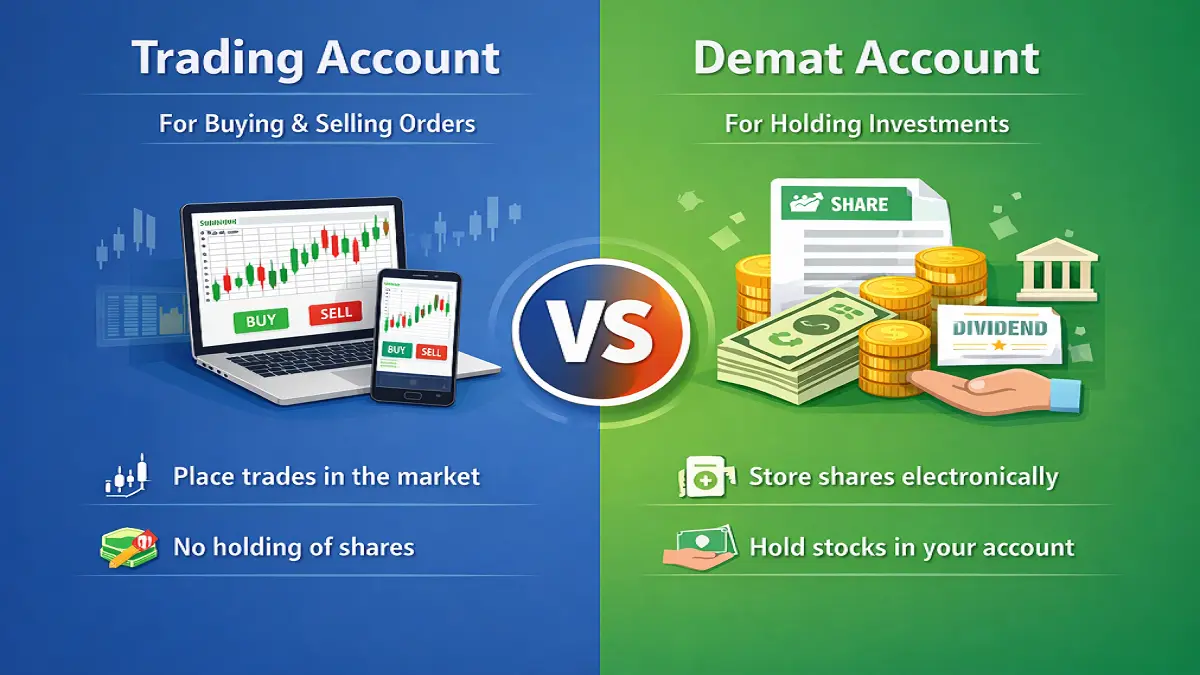
Trading and Demat Account are standard terms in the stock market and investing. Each of these terms is often used parallelly with the other In our last article, we learned what a Demat Account is. But guess what? Just having a Demat account is not enough to buy or sell shares. You need another important account called a Trading Account.
Today, I, Rajveer, will explain the Difference between Trading Account and Demat Account these two accounts with an example you will never forget!
1. What is a Trading Account?
A Trading Account is the platform where you place your orders to buy or sell shares.
In simple words, it’s like the “Buy” and “Sell” button that connects you to the stock market. When you use your mobile app (like Groww or Zerodha) to buy or sell shares, you are using your Trading Account
2. The Easiest Example: A Shop and a Locker
To understand the difference between a Trading Account and a Demat Account, let’s use an easy example:
- Trading Account = The Shop: Imagine you go to a shop. You choose an item, pay money, and buy it. The shop is where the buying and selling (transactions) happen. This is your Trading Account.
- Demat Account = The Locker/Vault: After buying the item from the shop, you take it home and keep it safely in your personal locker or vault. This locker is your Demat Account, where your shares are stored safely.
So, think of it this way: You need the “Shop” (Trading Account) to buy and sell shares, and you need the “Locker” (Demat Account) to keep those shares safe.
3. Key Differences Between Trading and Demat Accounts
Here’s a quick table to make it even clearer:
| Feature | Trading Account (The Shop) | Demat Account (The Locker) |
| Main Function | To buy or sell shares. | To store shares safely. |
| Nature | It’s an interface for transactions. | It’s a digital storage for your shares. |
| Role | Primarily used for holding securities safely , preventing loss and theft etc | Facilitates the execution of buy and sell orders on stock exchange |
| Unique Identifiers | Has a 16 digit number for identification. | Assigned a unique trading ID or separate broker ID. |
| Money Flow | Money moves in and out for buying/selling. | Only shares move in and out. No money. |
What is Demat Account and how to open demat account?
4. How does the whole process work? (Step-by-Step)
When you want to buy a share, here’s what happens:
- Money Transfer: You first transfer money from your Bank Account to your Trading Account.
- Place Order: You use your Trading Account to place the order to buy the shares.
- Storage: After you buy, the shares are transferred (usually in 1-2 days, called T+1) from the market to your Demat Account for safekeeping.
How to Open a Trading Account Without a Demat Account?
A Demat account is not compulsory if you only wish to trade in futures, options, and currency derivatives. These segments are cash-settled, which means there is no delivery or holding of shares, so a Demat account is not involved.
However, as per regulations issued by Securities and Exchange Board of India (SEBI), having a Demat account is mandatory for trading in equities, including equity intraday trading. This rule ensures proper settlement and transparency in equity transactions.
Fees and Charges of Trading Account & Demat Account
One important point to remember is that you can hold multiple Demat and Trading accounts using a single PAN, provided you comply with KYC norms. To use these accounts, certain standard fees and charges apply.
Below are the common costs associated with Demat and Trading accounts:
Demat and Trading Account Opening Charges
This is the fee charged by a broker to open your trading and Demat accounts. Some brokers offer zero account opening charges, allowing users to open accounts at no initial cost.
Demat / Remat Charges
These charges apply when:
- Physical share certificates are converted into electronic form (Dematerialisation), or
- Electronic shares are converted back into physical form (Rematerialisation).
Demat Annual Maintenance Charges (Demat AMC)
Most brokers charge an annual maintenance fee for keeping your Demat account active. The amount may differ from one service provider to another and covers the cost of account maintenance.
Brokerage Charges
Brokerage is the commission or fee charged by the broker for executing buy and sell orders on your behalf. The rate varies depending on the broker and the trading segment.
Off-Market Transfer Charges
These charges are applicable when shares are transferred between two Demat accounts without using the stock exchange, such as transferring shares to a family member or another personal account.
Summary
- Trading in derivatives and currencies can be done without a Demat account
- Equity trading requires a Demat account
- Multiple accounts can be held under one PAN
- Charges vary by broker and service type
5. Rajveer’s Simple Tip (Pro-Tip for Beginners)
Good news! Most modern brokers (like Groww, Zerodha, Upstox) offer a “2-in-1 Account.” This means when you open an account with them, your Trading Account and Demat Account are opened together. You don’t have to worry about managing them separately. It makes investing super easy!
Conclusion
In simple words, you can’t place orders without a Trading Account, and you can’t store your shares without a Demat Account. Both are equally important and work together to help you invest in the stock market.
Did you find this explanation easy to understand? If you still have any questions, feel free to ask in the comments below! I’d love to help you with more simple examples!
Also read :
- Regulatory Bodies in Indian Capital and Stock Market: Full Guide 2026
- STOP Saving, START SIP! This 7-3-2 Rule of Compounding in details guide
This article is for educational and informational purposes only. It is not any investment advice. Before making any investment-related decision, make sure to consult your financial advisor.